
Automatic Spray Painting Line for Automotive Mufflers: Improving Coating Consistency
Improving Coating Consistency in Automotive Muffler Production:
Why Automatic Spray Painting Lines Are Becoming the Industry Standard
Industry Background
Automotive mufflers (exhaust silencers) operate in high-temperature, high-corrosion environments. Their coating quality directly affects corrosion resistance, appearance consistency, and service life.
In many manufacturing plants, mufflers are still painted using semi-manual or fully manual spray methods. While flexible, these processes often struggle to meet the growing demands for stable quality, production efficiency, and environmental compliance.
As automotive suppliers face tighter quality standards and higher production volumes, automatic spray painting lines for mufflers are increasingly adopted as a practical upgrade solution.
Common Challenges in Manual Muffler Painting
Manual spray painting of automotive mufflers typically encounters several recurring issues:
Uneven coating thickness
Complex shapes, curved surfaces, and perforated structures make it difficult to achieve uniform coverage by hand.High dependency on operator skill
Coating quality varies significantly between operators and shifts, leading to unstable product consistency.Material waste and overspray
Manual spraying usually results in higher paint consumption and lower transfer efficiency.Inconsistent cycle time
Manual processes often struggle to match takt time requirements in medium- to high-volume production.
These challenges increase rework rates and quality inspection pressure, especially for export-oriented automotive components.
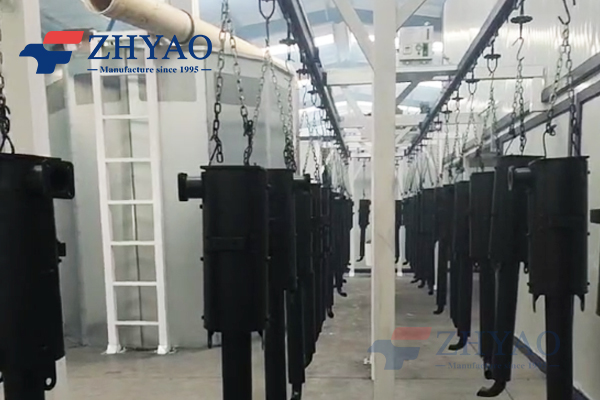
Automatic Spray Painting Line: A Systematic Solution
An automatic spray painting line designed specifically for automotive mufflers addresses these issues through process integration and precise control.
Key technical features typically include:
Programmable spray paths
Robots or reciprocators follow predefined trajectories, ensuring consistent coating on curved and recessed areas.Stable coating parameters
Spray distance, speed, and paint flow are controlled by PLC systems, reducing human-related variation.Optimized paint utilization
Controlled atomization and recovery systems help reduce overspray and improve paint transfer efficiency.Continuous production flow
Integration with conveyors and curing ovens allows stable cycle times and predictable output.
This system-based approach improves both coating quality and production efficiency without relying heavily on manual adjustments.
Application Results in Muffler Production
In practical applications, automotive manufacturers using automatic spray painting lines for mufflers have reported:
More uniform coating thickness across batches
Reduced rework caused by coating defects
Improved production rhythm and capacity stability
Better alignment with environmental and safety standards
While actual results depend on product design, paint type, and process configuration, automated solutions provide a more controllable and repeatable coating environment than manual methods.
For automotive muffler manufacturers seeking stable quality, scalable output, and long-term process reliability, automatic spray painting lines represent a logical evolution from manual painting.
Rather than focusing solely on equipment replacement, the key lies in designing a coating system that matches muffler geometry, production volume, and coating requirements.
A well-planned automatic spray painting line can help manufacturers achieve consistent coating performance while supporting modern automotive industry standards.
 Batch Oven vs. Continuous Oven: How to Choose the Right Curing System for Your Production Needs
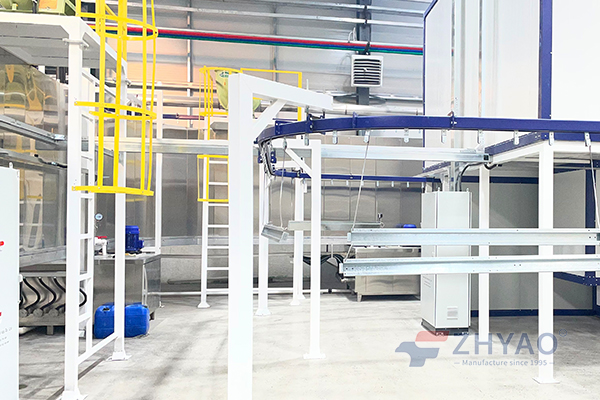 How Production Requirements Shape Powder Coating Line Design
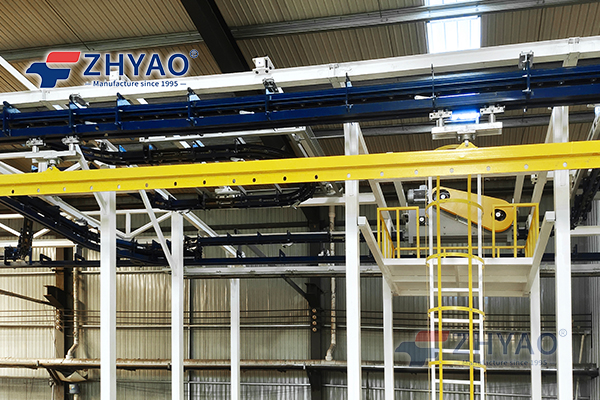 Automatic vs Manual Powder Coating Line
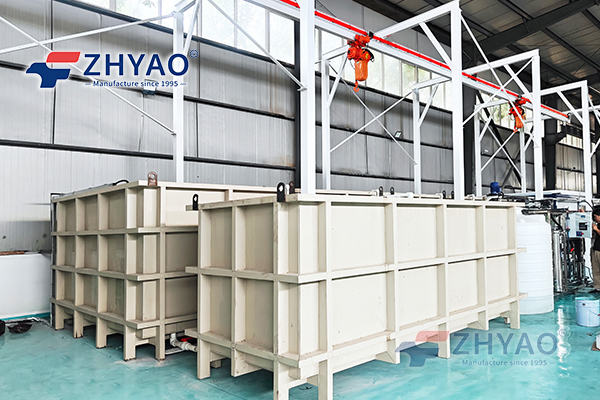 How Does Pretreatment Quality Affect Powder Coating Adhesion?