
How Production Requirements Shape Powder Coating Line Design
Production Requirements Should Determine the Equipment Configuration
A powder coating line should be designed around the products a factory needs to coat, the quantity it must produce, and the required finish quality. Selecting equipment first and trying to adapt the production process afterward can create capacity limitations, unnecessary investment, or inconsistent coating results.
The same principle applies to different manufacturing applications. A factory coating small metal components may benefit from compact spraying equipment and batch curing, while a manufacturer processing large steel frames may need a different conveyor arrangement, greater handling capacity, and more space for spraying and curing.
The key is to translate production requirements into equipment specifications before finalizing the line design.
Production Volume Determines the Line's Operating Rhythm
The required output affects conveyor speed, loading frequency, workpiece spacing, and the capacity of each processing stage.
However, a higher production target does not simply mean running the conveyor faster. Workpieces must receive adequate pretreatment, drying, powder application, and curing under the conditions required by the coating process.
If the curing oven cannot provide sufficient residence time at the planned conveyor speed, increasing throughput may compromise coating performance. Similarly, a spray booth that cannot maintain the required coverage at the target production rate may become a bottleneck.
For factories with relatively low or variable output, a batch system may offer greater flexibility. Higher-volume production with standardized products may justify a continuous conveyorized line. The appropriate configuration depends on the production schedule, product mix, and required operating efficiency.
Workpiece Size and Shape Affect Multiple Equipment Sections
The maximum workpiece dimensions are important, but the design must also account for shape, weight, hanging orientation, and the space required between adjacent parts.
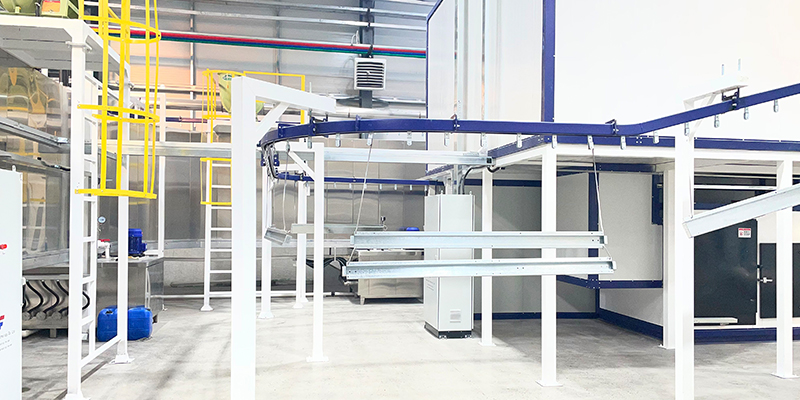
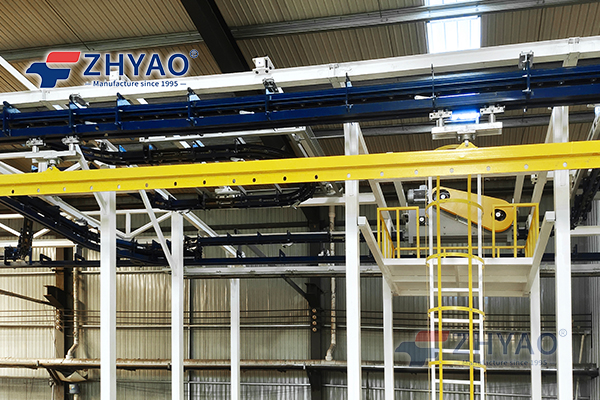
Large or heavy products may require stronger hangers, higher conveyor load capacity, and different handling arrangements. Long profiles or structural components may need a conveyor route that accommodates their length without interfering with surrounding equipment.
Workpiece geometry also affects spraying. Deep recesses, corners, narrow gaps, and complex structures can make uniform powder coverage more difficult. Automatic spray guns must be positioned and configured to suit the product geometry, while grounding and hanging arrangements need to support effective electrostatic deposition.
These requirements also influence booth dimensions and the usable space inside the curing oven. Consequently, changing the product size can affect several connected systems rather than just one machine.
Product Variety Influences Automation and Powder Recovery
A production line designed for a narrow range of standardized products can often use more repeatable loading arrangements and automatic spraying programs. When product dimensions and shapes vary significantly, the equipment needs sufficient flexibility to accommodate those changes.
Color requirements also matter. Frequent color changes can increase cleaning time and interrupt production, particularly when the same booth handles multiple powder colors. In such cases, the choice of booth structure, recovery system, cleaning access, and color-change arrangements should reflect the actual production schedule.
A highly automated system is not automatically the most suitable option for every factory. If product variety is high and production batches are small, a flexible manual or semi-automatic arrangement may be more practical. Where production volume is stable and products are standardized, automatic guns and reciprocators may help maintain a more consistent spraying process.
The objective is to automate the operations that improve production consistency and efficiency without introducing unnecessary complexity.
Curing Requirements Must Match the Production Rate
The curing oven must be designed around both the workpiece dimensions and the powder manufacturer's curing requirements.
Powder curing conditions are generally specified in relation to the actual workpiece temperature and the required time at that temperature, rather than oven air temperature alone. The time needed for a workpiece to heat up depends on factors such as its material, thickness, geometry, loading arrangement, and oven performance.
This distinction is especially important when a line processes products with different sizes or metal thicknesses. A setting suitable for a lightweight component may not provide the same thermal result for a heavier assembly.
When production output increases, the oven must still provide the necessary heating and curing conditions at the intended conveyor speed. Oven dimensions, heating capacity, airflow, and workpiece loading should therefore be evaluated together rather than selected independently.
Factory Conditions Also Influence the Final Design
Production requirements cannot be considered separately from the building in which the line will operate.
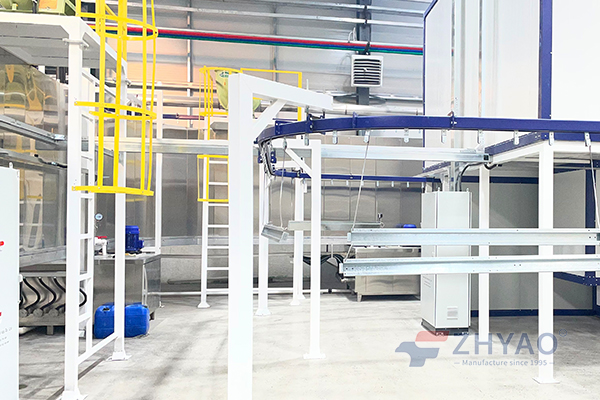
Available floor space, ceiling height, structural columns, loading areas, and existing equipment can influence conveyor routing and equipment placement. A straight-through layout may work well in a long workshop, while a U-shaped arrangement may be more practical where space is restricted.
The design must also preserve access for cleaning, inspection, and maintenance. A layout that fits the equipment into the available area but restricts routine servicing may create operational difficulties later.
For an existing factory, these constraints should be reviewed alongside the production target before equipment dimensions and the overall process layout are finalized.
What Information Is Needed Before Designing a Powder Coating Line?
A preliminary design becomes more reliable when the manufacturer can evaluate the actual production conditions. Useful information includes:
Product types, materials, and surface conditions.
Maximum and minimum workpiece dimensions and weights.
Required output per hour, shift, or day.
Expected product variety and batch sizes.
Powder colors and color-change frequency.
Required coating performance and curing specifications.
Available factory dimensions and layout drawings.
Preferred loading method and automation level.
These details help determine whether a batch, semi-automatic, or continuous line is appropriate and how pretreatment, spraying, conveying, recovery, and curing should be coordinated.
A well-designed powder coating line is not necessarily the one with the most equipment or the highest automation level. It is the system that can meet the factory's actual production requirements while maintaining coating quality, manageable operating costs, and room for practical maintenance.
FAQ
1. Does higher production output always require a fully automatic powder coating line?
No. Automation depends on product consistency, batch size, labor availability, and the required production rate. A batch or semi-automatic system may be suitable for variable production, while stable, high-volume manufacturing may benefit from continuous conveying and automatic spraying.
2. Why should workpiece dimensions be confirmed before designing a powder coating line?
Workpiece dimensions affect conveyor capacity, hanger spacing, spray booth size, pretreatment equipment, and curing oven design. Confirming the full product range helps prevent equipment limitations and ensures that the line can handle the intended products under actual operating conditions.
 Batch Oven vs. Continuous Oven: How to Choose the Right Curing System for Your Production Needs
 How Production Requirements Shape Powder Coating Line Design
 Automatic vs Manual Powder Coating Line
 How Does Pretreatment Quality Affect Powder Coating Adhesion?