
How Automation Can Reduce Labor Requirements in Powder Coating Production
Labor Requirements Depend on the Production Process
Labor demand in powder coating production is not determined by the number of machines alone. Loading, unloading, pretreatment, powder spraying, color changes, inspection, cleaning, and maintenance can all require operators.
Automation can reduce the amount of repetitive manual work, but the actual labor reduction depends on the product range and how the powder coating line is configured.
Automated Conveyors Reduce Material Handling
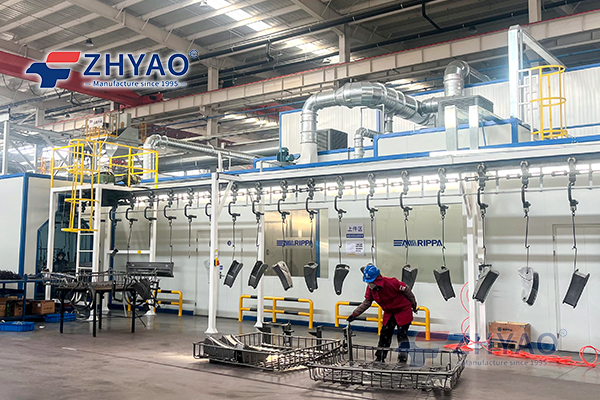
A conveyorized powder coating line can move workpieces between different process sections automatically. Operators do not need to manually transport products from pretreatment to drying, spraying, and curing.
For higher-volume production, automated conveying can make material flow more consistent and reduce repetitive handling work.
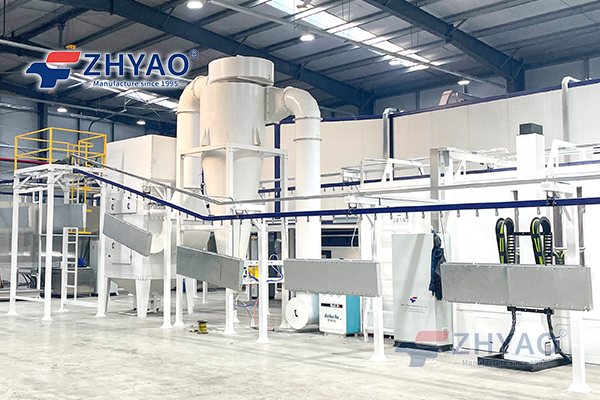
(ZHYAO Electrical Cabinet Powder Coating Line Project)
Automatic Powder Spraying Reduces Repetitive Spraying
Automatic spray guns and reciprocators can handle repeated spraying movements on products with relatively consistent shapes.
Instead of an operator continuously controlling the spray gun, the automatic equipment performs the programmed movement. Operators can then focus more on loading, process monitoring, inspection, and areas that require manual touch-up.
Pretreatment Can Also Be Automated
Pretreatment is another area where automation can reduce repetitive work. Depending on the product, spray pretreatment, immersion pretreatment, or shot blasting can be integrated into the production line.
Automated pumps, valves, conveyors, heating systems, and process controls can manage many routine operations that would otherwise require manual handling.
Automatic Powder Feeding Simplifies Material Handling
Automatic powder feeding systems can transfer powder from a powder supply unit to the spray equipment without requiring operators to repeatedly refill individual spray guns.
This can be particularly useful in continuous production, where stable powder supply is needed for extended operating periods.
Automation Does Not Eliminate Operators
Even a highly automated powder coating system still requires people. Operators may need to monitor equipment, inspect coating quality, clean the booth, change colors, maintain spray guns, check pretreatment conditions, and respond to abnormal situations.
The role changes from performing every repetitive operation manually to managing and monitoring the production process.
Product Variety Changes the Labor Calculation
Automation works most efficiently when workpieces have relatively consistent dimensions and repeatable coating requirements.
Factories producing many different products may still need manual spraying, manual loading, or additional adjustment. In these cases, combining automatic equipment with manual operations can provide more practical flexibility.
Calculate Labor Savings From the Whole Line
When evaluating automation, manufacturers should compare the labor requirements of the complete process rather than looking only at automatic spray guns.
Conveyor handling, pretreatment, powder feeding, spraying, unloading, cleaning, and inspection should all be considered. This gives a more realistic picture of how automation changes staffing requirements.
Conclusion: Automate the Repetitive Work First
The practical purpose of automation in powder coating production is not simply to replace operators. It is to reduce repetitive handling and spraying tasks while keeping people responsible for process control, quality inspection, maintenance, and production decisions.
For manufacturers considering an automated powder coating system, the right starting point is to identify which operations consume the most labor and then determine where automation can provide a measurable improvement.
FAQ
How does automation reduce labor in powder coating production?
Automated conveyors, spray guns, reciprocators, pretreatment equipment, and powder feeding systems can reduce repetitive handling, spraying, and material-transfer tasks.
Can a powder coating line combine automatic and manual operations?
Yes. A mixed configuration is often practical when products vary in size or shape. Automatic equipment can handle repeatable surfaces while operators manage complex areas and production adjustments.
 Powder Coating Line Cost: What Affects the Investment?
 How Automation Can Reduce Labor Requirements in Powder Coating Production
 How to Calculate the Production Capacity of a Powder Coating Line
 Powder Coating Line Process Explained: From Pretreatment to Final Curing