
How to Calculate the Production Capacity of a Powder Coating Line
Key Factors Behind the Real Output of a Powder Coating System
Production Capacity Is More Than Conveyor Speed
The production capacity of a powder coating line is usually expressed as pieces per hour, pieces per shift, or coated surface area per hour. Conveyor speed is important, but it does not determine output by itself.
Workpiece size, hanger spacing, loading quantity, pretreatment time, curing time, and operating efficiency all affect the actual production capacity.
Start With the Required Output
A practical calculation begins with the target production volume. For example, if a factory needs to process 800 workpieces during an 8-hour shift, the average required output is 100 pieces per hour.
This target can then be used to determine the required conveyor speed and carrier arrangement.
Calculate Capacity From Carrier Spacing
For a conveyorized powder coating line, a simple production calculation is:
Production Capacity = Carriers per Hour × Workpieces per Carrier
If the conveyor carries one workpiece on each carrier, the carrier spacing and conveyor speed directly affect the hourly output.
For example, with a 1-meter carrier pitch and a conveyor speed of 6 meters per minute, approximately 6 carriers pass a point each minute, or about 360 carriers per hour.
The actual output will be lower if some carriers are unused or if loading and unloading cannot keep up.
Consider the Workpiece Size
A larger workpiece usually requires more hanger space. This reduces the number of workpieces that can be transported through the line at the same conveyor speed.
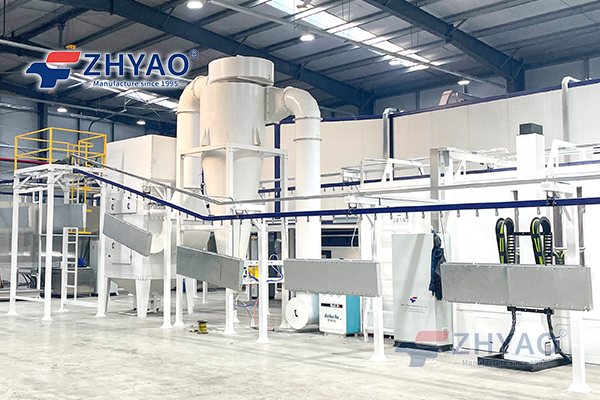
Workpiece dimensions also affect the powder coating booth and curing oven. The oven must provide sufficient residence time for the powder to reach the required curing conditions.
Check the Process Bottleneck
The pretreatment line, drying oven, powder spraying section, and curing oven all need to support the planned production rate.
Increasing conveyor speed without increasing available processing capacity can result in insufficient pretreatment or curing time. Therefore, production capacity should be checked across the complete powder coating process.
Account for Real Operating Conditions
Theoretical capacity and actual production are not always the same. Loading delays, color changes, cleaning, maintenance, rejected parts, and temporary equipment stoppages can reduce effective output.
A realistic production calculation should therefore include an operating factor rather than assuming the line runs continuously at its theoretical rate.
Conclusion
Calculating powder coating line capacity requires more than selecting a conveyor speed. Manufacturers should consider target output, carrier spacing, workpiece quantity per carrier, workpiece dimensions, process times, and actual operating conditions.
A suitable powder coating line should be sized around the required production rate while keeping pretreatment, spraying, and curing processes properly matched.
FAQ
How is powder coating line capacity calculated?
A basic calculation uses conveyor carriers per hour multiplied by the number of workpieces loaded on each carrier, followed by adjustment for actual operating efficiency.
Does a faster conveyor always increase production capacity?
No. The conveyor speed must remain compatible with pretreatment, drying, powder spraying, and curing requirements. Increasing speed beyond the process capability can affect coating quality.
 Automatic vs Manual Powder Coating Line
 How Does Pretreatment Quality Affect Powder Coating Adhesion?
 How Does Conveyor Pitch Affect Powder Coating Production?
 Powder Coating Line with Tunnel Oven