
How Does Conveyor Pitch Affect Powder Coating Production?
How conveyor spacing influences production capacity, coating access, curing, and the overall design of an automatic powder coating line
Conveyor Pitch Is More Than a Spacing Setting
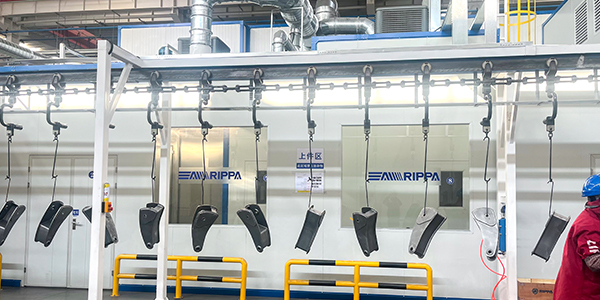
In a powder coating line, conveyor pitch refers to the distance between two adjacent workpiece hanging positions.
It may look like a simple mechanical setting, but it directly affects how many products can enter the line, how much coating space each product receives, and how efficiently the available oven, spray booth, and conveyor length are used.
A suitable conveyor pitch is therefore not simply about hanging as many parts as possible. The right spacing depends on the workpiece size, coating process, production target, and movement of the parts through each section of the line.
Smaller Pitch Can Increase Production Density
When workpieces are relatively small and have simple shapes, reducing the conveyor pitch allows more products to pass through a fixed section of conveyor in the same period.
For example, if the conveyor moves at a constant speed, closer hanging positions mean that more workpieces can enter the pretreatment, spraying, and curing areas during an hour. This can increase production density without extending the physical length of the line.
However, there is a practical limit. If parts are placed too close together, the benefit of higher density can quickly be offset by problems in spraying, handling, or curing.
Large Workpieces Need More Space
Large cabinets, frames, doors, fences, and other bulky products usually require a larger conveyor pitch. The workpieces need enough clearance to avoid touching each other when the conveyor moves around curves or changes direction.
Spacing also needs to account for the actual dimensions of the product rather than just its width. Long or irregularly shaped parts may swing during transportation, especially on suspended conveyor systems.
For this reason, conveyor pitch is normally determined after considering the workpiece envelope, including its height, width, length, and hanging orientation.
Conveyor Pitch Affects Powder Gun Coverage
The relationship between pitch and automatic spray gun movement is often overlooked.
When products are too close together, one workpiece can partially block another from the spray guns. This is especially noticeable with products containing deep corners, frames, overlapping surfaces, or complicated structures.
A reasonable pitch gives the spray guns enough time and space to coat the required surfaces as each workpiece passes through the spraying zone.
For automatic powder coating lines, the pitch should therefore be considered together with gun quantity, gun position, reciprocator movement, and conveyor speed.
Faraday Areas Make Spacing More Important
Metal products with narrow corners, recesses, and enclosed sections can create Faraday cage effects during electrostatic powder coating.
Increasing the distance between workpieces cannot eliminate this problem by itself, but excessive crowding can make coating access even more difficult.
For these products, the conveyor arrangement, hanging method, spray angle, and gun movement need to work together. Sometimes changing how the product is hung can provide a greater improvement than simply changing the conveyor pitch.
Conveyor Speed and Pitch Work Together
Pitch should never be evaluated independently from conveyor speed.
A simple production relationship is:
Production rate ≈ Conveyor speed ÷ Conveyor pitch
For example, if the conveyor moves at 6 meters per minute and the pitch is 1 meter, the theoretical hanging frequency is about 6 positions per minute.
If the pitch is reduced to 0.75 meters at the same speed, the theoretical frequency increases to about 8 positions per minute.
But this does not mean actual finished-product output will automatically increase by the same proportion. The real output is also limited by loading, coating quality, curing time, workpiece handling, and other parts of the production line.
The Oven Creates Another Limitation
A powder coating line needs to maintain the required curing conditions for the powder coating material. The conveyor must keep each workpiece inside the effective curing zone for the required time.
This means pitch and conveyor speed influence how many workpieces are simultaneously inside the curing oven.
If production density is increased without checking the oven capacity, the line may create a higher workload without providing enough effective curing capacity. Oven design, temperature distribution, workpiece mass, and curing requirements all need to be considered.
Pretreatment Also Needs Enough Space
The same principle applies to pretreatment.
Whether a line uses spray pretreatment, immersion tank pretreatment, or shot blasting, workpieces must move through the process without excessive interference from adjacent products.
For spray pretreatment, dense loading may affect spray coverage and drainage. With immersion pretreatment, the hanging arrangement can influence how easily the workpiece enters and exits the tank and whether liquid can reach the required surfaces.
This is one reason conveyor pitch should be determined during the overall line design rather than added as an isolated conveyor specification.
Hanging Method Can Change the Required Pitch
Two production lines may coat the same product but use different conveyor pitches because their hanging methods are different.
A single large workpiece may occupy one hanger position, while several small components may be mounted on one hanger. In the second case, the effective production output can be much higher without necessarily increasing conveyor speed.
The key is to look at parts per hanger, not only hanger-to-hanger distance. For small hardware products, optimizing the hanging fixture can sometimes have a larger impact on production capacity than changing the conveyor pitch itself.
Too Much Spacing Also Has a Cost
Increasing the pitch is not always safer.
If the spacing is much larger than necessary, fewer workpieces pass through the line during the same operating period. The conveyor, oven, and spray booth may then be operating below their available capacity.
A longer pitch can also increase the required conveyor length when a specific curing time or process residence time must be maintained at a given conveyor speed.
The goal is not maximum spacing or minimum spacing. It is to match the spacing with the actual production conditions.
How to Choose a Practical Conveyor Pitch
A useful design process starts with the product rather than the conveyor itself.
First, determine the typical and maximum workpiece dimensions. Then confirm the hanging orientation and whether one hanger carries one part or multiple parts.
Next, calculate the required production output and select a reasonable conveyor speed. From there, the pitch can be evaluated together with the spraying zone, pretreatment equipment, curing oven, and loading and unloading operations.
If several product sizes will share the same line, it is also worth checking the largest or most demanding product rather than designing only around the smallest part.
Conveyor Pitch Should Leave Room for Future Production
Production requirements often change after a coating line has been installed. A factory may add a new product, increase output, or change the way products are hung.
For this reason, a conveyor system should not be designed around a single production condition with no flexibility. A practical design considers the range of workpieces that the line is expected to handle.
For manufacturers planning an automatic powder coating line, conveyor pitch is one part of a larger production calculation involving workpiece dimensions, hanger design, conveyor speed, pretreatment, automatic spraying, powder recovery, curing, and actual daily output.
The Right Pitch Is a Balance
Conveyor pitch affects production density, coating access, curing capacity, equipment utilization, and the overall length of a powder coating line.
Reducing the pitch can increase the number of workpieces on the conveyor, but only when the rest of the system can handle the additional production density.
For a new powder coating line, the better approach is to calculate pitch from the actual product and production target rather than selecting a standard spacing first.
For an existing line, changing the pitch may improve output, but the effects on spraying, curing, handling, and product quality should be checked at the same time.
Frequently Asked Questions
- What happens if the conveyor pitch is too small in a powder coating line?
Workpieces may interfere with each other during spraying and transportation. Coating access can become more difficult, and parts may touch or collide if their shapes or movement require more clearance.
- Does reducing conveyor pitch always increase powder coating production?
No. It can increase the theoretical number of workpieces passing through the line, but actual production is also limited by spraying capacity, pretreatment, curing, loading, unloading, and coating quality.
 How Does Pretreatment Quality Affect Powder Coating Adhesion?
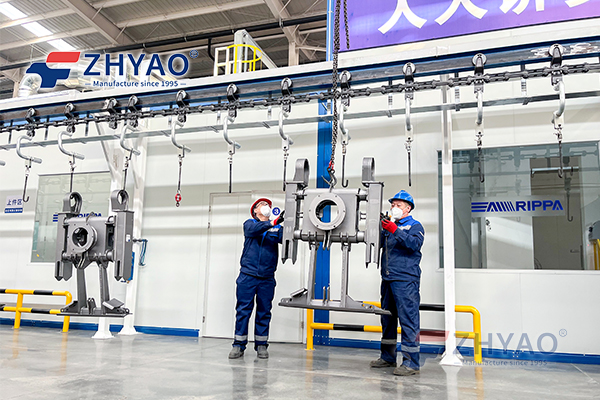 How Does Conveyor Pitch Affect Powder Coating Production?
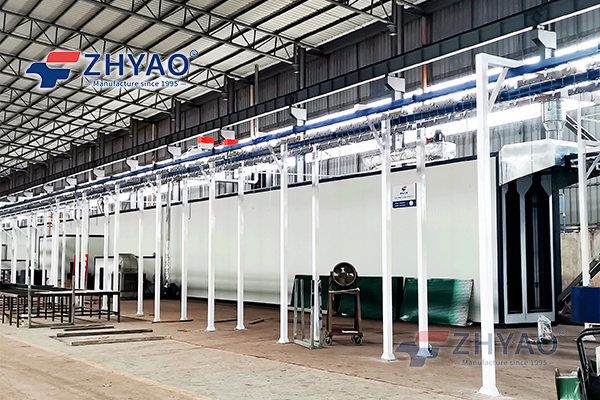 Powder Coating Line with Tunnel Oven
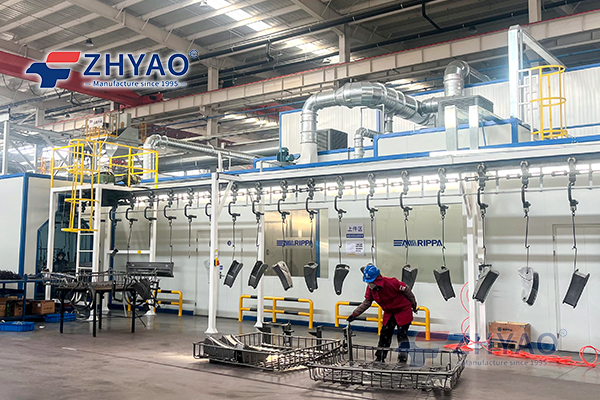 Powder Coating Line Cost: What Affects the Investment?