
How Long Does an Automated Powder Coating Line Take to Pay Back? A Practical Guide to ROI Calculation
Investing in an automated powder coating line is a major financial decision for any manufacturer. While automation promises improved efficiency and consistent quality, the key question remains: how long will it take to recover the investment?
The answer depends on several measurable factors. Understanding how to calculate return on investment (ROI) helps manufacturers make informed and strategic decisions.
Step 1: Identify Total Investment Cost
The first step is determining the total capital investment, which may include:
Powder coating booth system
Automatic spray guns and control systems
Conveyor system
Curing oven
Powder recovery system
Installation and commissioning costs
For ROI calculation, all equipment, setup, and integration costs should be included.
Step 2: Calculate Annual Labor Cost Savings
One of the most direct financial benefits of automation is reduced labor dependency.
Example:
If manual spraying requires 4 operators per shift and automation reduces that to 1–2 operators, the annual labor savings can be calculated as:
Annual Labor Savings = (Number of Reduced Workers × Annual Salary per Worker)
In regions with rising wages, this factor alone can significantly shorten the payback period.
Step 3: Estimate Material Savings
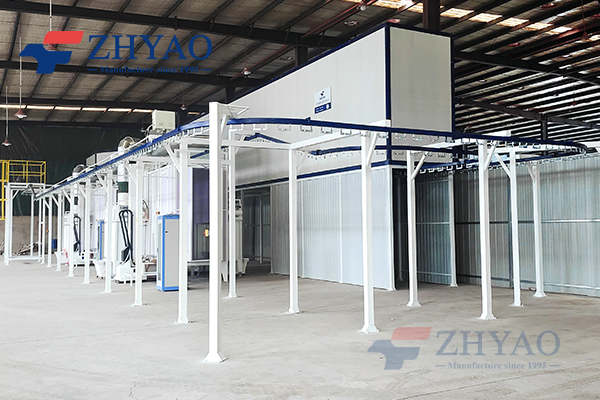
Automated powder coating lines typically improve powder utilization efficiency through optimized airflow and recovery systems.
Manual spraying may result in higher overspray and waste, while automated systems can increase recovery efficiency and reduce powder consumption.
Material savings can be estimated by comparing:
Annual powder usage before automation
Projected powder usage after automation
Even a 5–10% improvement in utilization can translate into substantial yearly savings for high-volume production.
Step 4: Evaluate Reduced Rework and Defect Costs
Inconsistent coating thickness, missed edges, and uneven finishes often lead to rework.
Rework costs include:
Additional labor
Extra powder usage
Production delays
If automation reduces rework rates, those savings should be included in ROI calculations.
Step 5: Consider Increased Production Capacity
Automation often increases throughput. Higher capacity allows manufacturers to:
Accept more orders
Reduce overtime
Shorten delivery cycles
Additional revenue generated from increased production should be factored into ROI evaluation.
Basic ROI Formula
A simplified payback calculation:
Payback Period (Years) =
Total Investment Cost ÷ Annual Net Savings
Where Annual Net Savings includes:
Labor savings
Material savings
Reduced rework costs
Additional profit from increased capacity
Typical Payback Range
In many manufacturing environments, automated powder coating lines reach payback within:
2 to 4 years for medium-volume production
Shorter periods in high-labor-cost regions
Longer periods for low-volume or highly customized production
Actual results depend on production scale, labor cost structure, and operational efficiency.
Beyond Financial Return
While ROI is critical, automation also brings:
More consistent quality
Stronger competitiveness in export markets
Improved workplace safety
Better production stability
For growing manufacturers, automation is often both a financial and strategic decision.
 Batch Oven vs. Continuous Oven: How to Choose the Right Curing System for Your Production Needs
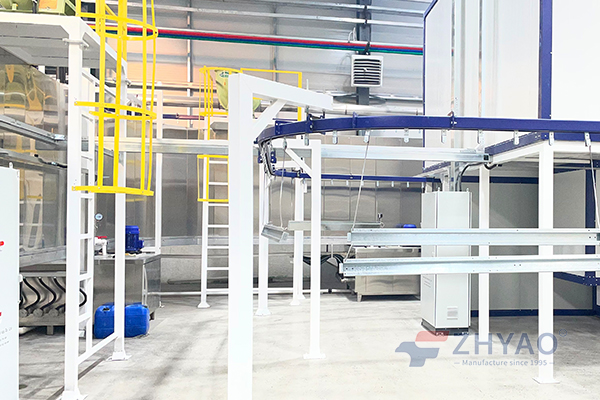 How Production Requirements Shape Powder Coating Line Design
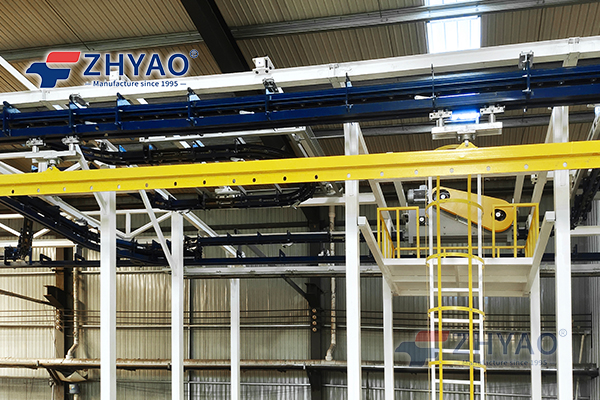 Automatic vs Manual Powder Coating Line
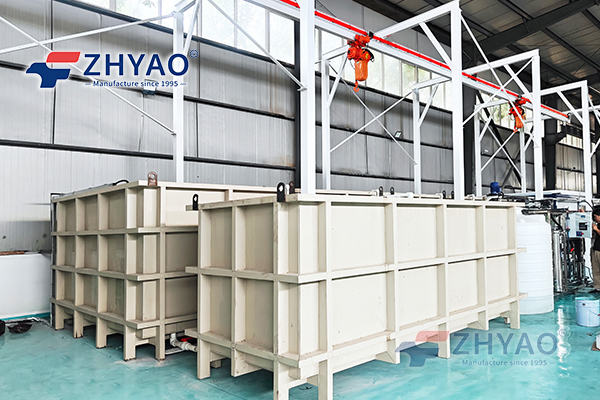 How Does Pretreatment Quality Affect Powder Coating Adhesion?