
Why Powder Coating Creates a Durable Surface Layer
Powder coating durability is a key performance factor in industrial coating systems. Understanding why powder coating creates a durable protective surface layer is essential for improving coating quality in an automatic painting line. The durability is not caused by a single factor, but by the combined effects of electrostatic application, curing chemistry, surface pretreatment, and process stability in industrial production.
1. Electrostatic Application Creates Strong Initial Adhesion
One of the first reasons powder coating forms a durable surface is the electrostatic deposition process.
During spraying, powder particles are electrically charged and attracted to the grounded metal workpiece. This process ensures:
High transfer efficiency
Uniform powder coverage
Strong initial bonding before curing
Compared with liquid paint, which relies mainly on surface wetting, electrostatic powder coating creates a more stable and evenly distributed coating layer at the initial stage.
In an automatic painting line system, stable electrostatic voltage and spray control directly affect coating uniformity and long-term durability.
2. Thermal Curing Forms a Cross-Linked Polymer Structure
The curing process is the most critical stage in determining final coating durability.
Inside the curing oven, powder particles melt and undergo chemical cross-linking reactions. This transforms the coating into a dense and stable polymer film.
The main results of curing include:
Formation of a continuous coating layer
Increased hardness and mechanical strength
Improved resistance to corrosion and chemicals
This cross-linked molecular structure is one of the main reasons powder coating performs better than simple air-dried coatings.
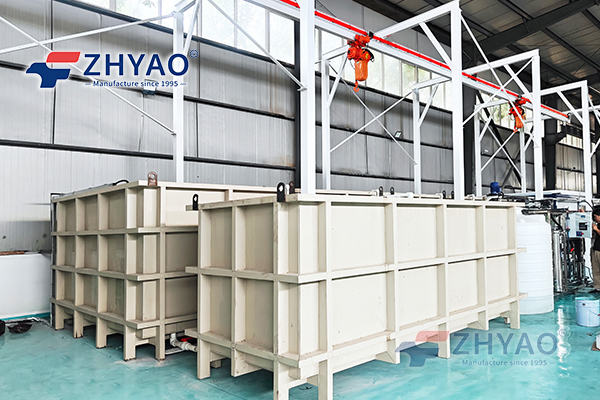
3. Surface Pretreatment Improves Long-Term Adhesion
Durability also depends heavily on surface preparation before coating.
Pretreatment removes contaminants such as:
Oil and grease
Rust and oxidation
Dust and industrial residues
Common industrial pretreatment processes include degreasing, rinsing, and chemical conversion coating.
A properly prepared surface allows the powder coating layer to bond more effectively with the metal substrate, reducing risks of peeling, blistering, or early failure during service life.
4. Flow and Leveling Behavior During Curing
When the coated workpiece enters the curing oven, the powder first melts and then flows before solidifying.
This physical behavior helps:
Fill micro-level surface irregularities
Reduce coating defects
Improve surface smoothness and uniformity
As a result, the final coating layer becomes dense and continuous, with fewer weak points that could reduce durability.
5. Dense Coating Film Without Solvent Evaporation
Powder coating does not contain solvents, which is another important reason for its durability.
Unlike liquid paint systems, powder coating does not experience volume shrinkage caused by solvent evaporation. This results in:
Lower porosity
More stable film thickness
Reduced internal stress in the coating layer
The dense structure significantly improves resistance to environmental aging and mechanical wear.
6. Environmental and Mechanical Resistance
A properly cured powder coating layer provides strong resistance against:
Moisture and humidity
UV radiation exposure
Temperature fluctuations
Mechanical impact and abrasion
These properties make powder coating widely used in industries such as metal furniture, automotive components, aluminum profiles, and construction hardware.
7. Process Stability in Automatic Painting Line Systems
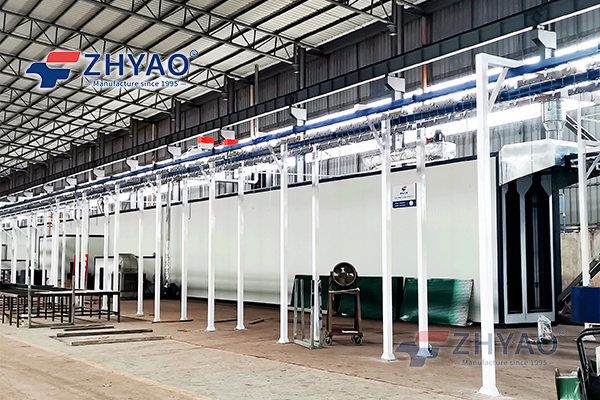
In industrial production, coating durability is also influenced by the stability of the automatic painting line system.
Key factors include:
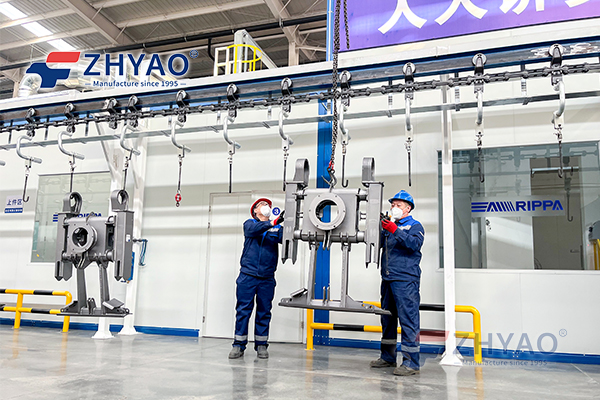
Consistent conveyor speed control
Stable curing temperature distribution
Uniform spray parameters
Efficient powder recovery and reuse system
When these parameters are well controlled, the coating layer becomes more consistent, which directly improves product durability and reduces quality variation.
8. Industrial Engineering Perspective
From an industrial engineering perspective, powder coating durability is the result of coordinated control across multiple subsystems rather than a single process step.
The final coating performance depends on the interaction between pretreatment quality, electrostatic efficiency, curing kinetics, and automation stability within the full production line system.
Powder coating forms a durable surface layer due to the combined effects of electrostatic deposition, thermal cross-linking, surface pretreatment, and stable process control in an automatic painting line. These mechanisms work together to create a dense, strong, and long-lasting protective coating.
Understanding these principles helps manufacturers optimize coating systems and improve industrial surface finishing performance.
 Automatic vs Manual Powder Coating Line
 How Does Pretreatment Quality Affect Powder Coating Adhesion?
 How Does Conveyor Pitch Affect Powder Coating Production?
 Powder Coating Line with Tunnel Oven