
Powder Coating vs Liquid Painting: Which Process Is Better for Your Product?
Powder coating and liquid painting can both provide durable, attractive finishes, but they are not interchangeable in every manufacturing application. The better choice depends on the workpiece material, required coating performance, production volume, and available curing conditions.
For repetitive production of heat-resistant metal parts, powder coating is often worth evaluating first because of its potential for efficient material recovery and automated application. Liquid painting is often more practical for heat-sensitive substrates, on-site work, and applications requiring specific coating systems or multilayer finishes.
The key is to select a process that meets the product specification without creating unnecessary production constraints.
Powder Coating: When Durability and Repeatable Production Matter
Powder coating applies dry coating particles to a workpiece, commonly through electrostatic spraying. The coated part then enters a curing oven, where heat allows the powder to melt, flow, and form a continuous film.
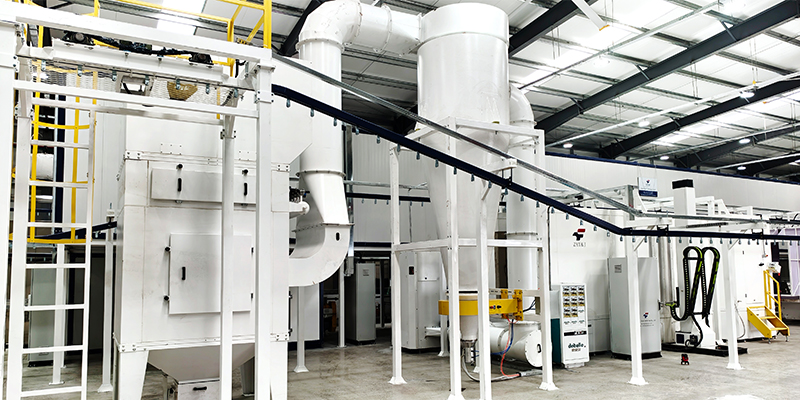
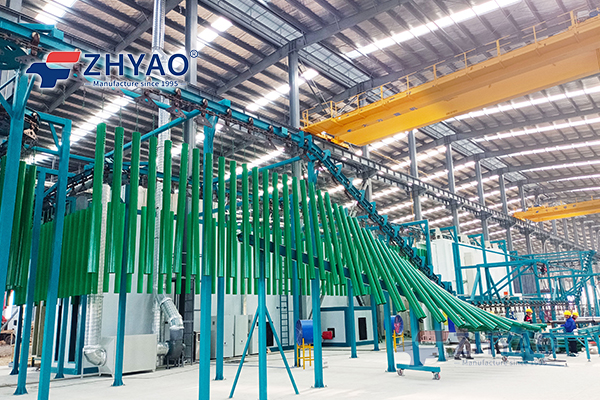
(A powder coating line customized by ZHYAO for a client in the power distribution cabinet industry.)
1. Durable Protection for Metal Products
Powder coatings can provide good resistance to impact, abrasion, moisture, and environmental exposure when the coating formulation and application process are appropriate.
This makes powder coating suitable for products such as electrical cabinets, metal furniture, machinery components, guardrails, and construction hardware.
However, durability depends on more than the coating material. Surface preparation, film thickness, coating formulation, and curing conditions all affect the final result. Products exposed to harsh outdoor environments may require a specialized coating system rather than a standard powder formulation.
2. Material Recovery Can Reduce Waste
During powder spraying, some coating particles miss the workpiece. A suitable recovery system can collect a portion of this overspray for reuse.
For manufacturers processing large quantities of similar products, this can improve material utilization. The actual benefit depends on booth design, powder characteristics, contamination control, and operating practices.
Frequent color changes can complicate recovery because the booth, filters, and powder circuits may need cleaning. For products with strict appearance requirements, recycled powder also requires appropriate quality control.
3. Suitable for Automated Coating Lines
Powder coating can be integrated with automatic spray guns, reciprocators, conveyors, recovery equipment, and curing ovens.
When products have consistent dimensions and production schedules, automation can improve coating repeatability and reduce the manual work required for large production runs.
Complex shapes, recessed areas, and difficult-to-reach surfaces may still require careful gun positioning or manual touch-up. Automation also does not eliminate the need for process control: poor grounding, unsuitable spray settings, or incorrect curing can still produce coating defects.
Liquid Painting: When Flexibility Is the Priority
Liquid painting applies wet paint using spraying, dipping, brushing, or other application methods. Depending on the formulation, the coating dries through carrier evaporation, chemical reaction, or a combination of both.
Its main advantage is flexibility across different materials, working environments, and coating specifications.
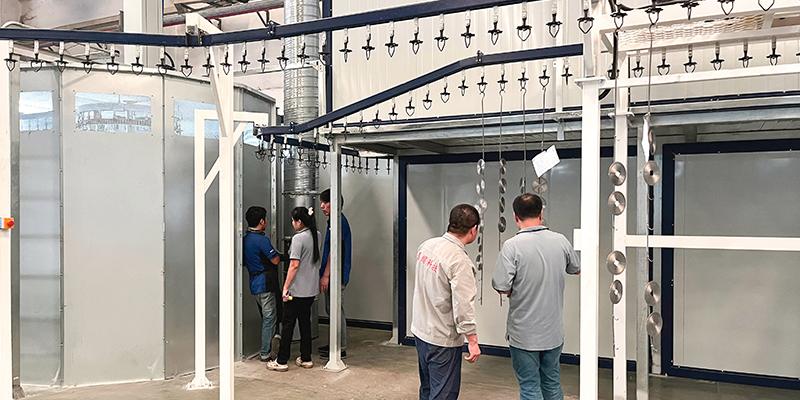
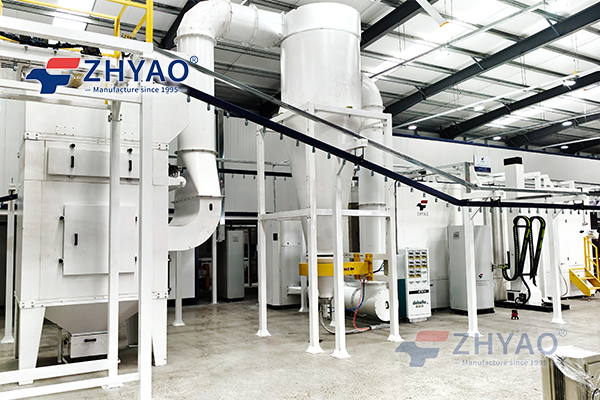
(A custom-designed painting production line built by ZHYAO for a Thai client in the diamond saw blade industry.)
1. More Options for Heat-Sensitive Materials
Conventional powder coating usually requires the workpiece to withstand a defined curing temperature and time. This can limit its suitability for temperature-sensitive plastics, assembled components, or products containing heat-sensitive materials.
Liquid coatings are available for many substrates and can use different drying or curing mechanisms. This makes them useful when conventional powder curing is impractical.
The coating must still be compatible with the substrate, and its drying or curing requirements must be satisfied. Low-temperature powder coatings may also be an option in certain applications, so the actual product specification should determine the choice.
2. Flexibility in Appearance and Coating Systems
Liquid painting supports a wide range of colors, gloss levels, metallic effects, primers, and topcoats. It can be especially useful when a product requires a particular decorative finish or a specified multilayer protective system.
For example, large machinery may require a primer for corrosion protection and a compatible topcoat for weather resistance and appearance.
Powder coating can also achieve many decorative and protective finishes. The deciding factor is whether the available coating system meets the required appearance, thickness, adhesion, and service-life expectations.
3. Practical for Large Structures and On-Site Work
A large steel structure or installed industrial machine may be difficult to transport through a coating line or fit inside a curing oven. Liquid painting can be applied on-site when environmental, safety, and application conditions permit.
It is also useful for localized repairs and touch-ups because compatible liquid coatings can often be applied directly to prepared areas without placing the entire component in an oven.
Powder-coated surfaces can also be repaired, but matching the original finish and restoring the specified coating performance may require additional preparation and a suitable repair system.
4. An Option for Diverse Products and Small Batches
Manufacturers producing small quantities of many product types may benefit from the flexibility of liquid painting. Depending on the equipment and coating system, switching between colors or formulations may be more practical than cleaning a powder booth and recovery circuit.
However, liquid painting also involves color preparation, equipment cleaning, flushing, overspray management, and drying or curing time. The best choice depends on actual changeover time, batch size, labor, and material waste—not simply on the coating method.
Which Process Fits Your Product?
The product itself often provides the clearest starting point for selection.
Metal Furniture and Electrical Cabinets
Powder coating is often suitable for heat-resistant metal products manufactured in repeated batches. Automated spraying and powder recovery can support consistent production.
Liquid painting may be preferable when the product requires a specific decorative finish, a specialized multilayer system, or a coating process that better suits its substrate and production conditions.
Agricultural Machinery and Heavy Equipment
The choice depends on component size, coating specifications, and curing feasibility. Smaller metal components that can pass through a suitable curing oven may be good candidates for powder coating.
Large assembled equipment, components containing heat-sensitive materials, or machinery painted at its installation site may be better suited to liquid painting.
For either method, corrosion protection depends on the complete coating system, including surface preparation, primer requirements where applicable, and the intended operating environment.
Guardrails, Fences, and Outdoor Metal Products
Powder coating can provide an effective finish for outdoor metal components when the pretreatment and coating formulation are selected for the exposure conditions.
Liquid coating can also deliver strong outdoor performance, particularly when the specification calls for a compatible primer and topcoat system.
Neither method automatically guarantees a longer service life. UV exposure, moisture, corrosion risk, edge coverage, film thickness, and maintenance requirements should all be considered.
Products With Frequent Color Changes
Color changes can affect productivity regardless of the coating method.
In powder coating, changing colors may require cleaning the booth, recovery system, and powder delivery components. Dedicated booths or separate recovery arrangements can reduce changeover time, but they require additional space and investment.
Liquid painting may simplify certain color changes, but paint lines still need cleaning and flushing, and residual material must be managed properly.
For production involving many colors, compare the number of changes per shift, typical batch size, cleaning labor, material loss, and lost production time before deciding which process is more suitable.
How Do Powder Coating and Liquid Painting Compare in Operating Conditions?
The following comparison highlights the main factors that typically influence process selection.
Substrate compatibility: Liquid painting offers options for a wide range of materials, while conventional powder coating is most commonly used for substrates that can tolerate its application and curing requirements.
Material utilization: Powder overspray can be recovered with a suitable system. Liquid paint overspray requires separate handling and is not generally recovered for reuse in the same way.
Curing requirements: Powder coating requires an appropriate curing cycle. Liquid coatings may air-dry or require heat, depending on the formulation.
Automation: Both processes can be automated. The best configuration depends on product geometry, production volume, coating requirements, and changeover frequency.
On-site application: Liquid painting is generally more practical for large installed structures and equipment that cannot enter a coating line.
Finish and durability: Both methods can meet demanding requirements when the coating system and application process are properly selected.
How to Choose Without Creating Unnecessary Production Costs
Before selecting a coating process, confirm five essential conditions.
Workpiece material and dimensions: Establish substrate compatibility, maximum allowable temperature, and whether the product can fit through the proposed equipment.
Required coating performance: Define appearance, adhesion, film thickness, corrosion resistance, chemical exposure, and weathering requirements.
Production volume and product mix: Consider daily output, batch sizes, product variety, and the frequency of color changes.
Available manufacturing conditions: Check whether the factory has adequate space, ventilation, curing facilities, pretreatment equipment, and environmental controls.
Total process requirements: Evaluate coating consumption, recovery or waste handling, energy, labor, maintenance, cleaning, and expected downtime.
A process with lower material consumption may not be the most economical if it requires expensive changeovers or cannot meet the required production rate. Likewise, a flexible process may not be the best choice for a stable, high-volume product if another system can deliver the required finish more efficiently.
The correct decision comes from matching the coating process to the product and production conditions—not from assuming that one technology is always better.
FAQ
1. Is powder coating cheaper than liquid painting for high-volume production?
Powder coating can offer favorable operating economics for repetitive production because suitable recovery systems reduce material waste and automation can improve consistency. However, curing energy, equipment utilization, color-change frequency, and maintenance also affect the total cost. A fair comparison should use the same product specification and production target.
2. Can liquid painting replace powder coating for metal products?
In many applications, yes, provided the liquid coating system meets the required performance and production conditions. Liquid painting may be preferable for heat-sensitive assemblies, on-site work, or specialized multilayer finishes. Powder coating may be more suitable for heat-resistant metal parts produced repeatedly in a controlled manufacturing environment.
 Vertical vs. Horizontal Conveyor Systems in Painting Lines: How to Choose the Right Layout
 Powder Coating vs Liquid Painting: Which Process Is Better for Your Product?
 Batch Oven vs. Continuous Oven: How to Choose the Right Curing System for Your Production Needs
 How Production Requirements Shape Powder Coating Line Design