
Vertical vs. Horizontal Conveyor Systems in Painting Lines: How to Choose the Right Layout
Choosing between a vertical and a horizontal conveyor system is not simply a matter of saving floor space or selecting a particular conveyor structure. The decision affects how workpieces are loaded, how they move through the painting process, how easily spray guns reach their surfaces, and how the entire production line is arranged.
A conveyor layout that works well for one product may create unnecessary handling or coating difficulties for another. Long profiles, large sheet-metal components, and irregularly shaped parts have different transportation requirements.
The most suitable system is therefore determined by the relationship between the workpiece, the coating process, and the production layout—not by the conveyor orientation alone.
Workpiece Geometry Should Determine the Conveyor Layout
The first consideration is how the workpiece can be transported without interfering with the coating process.
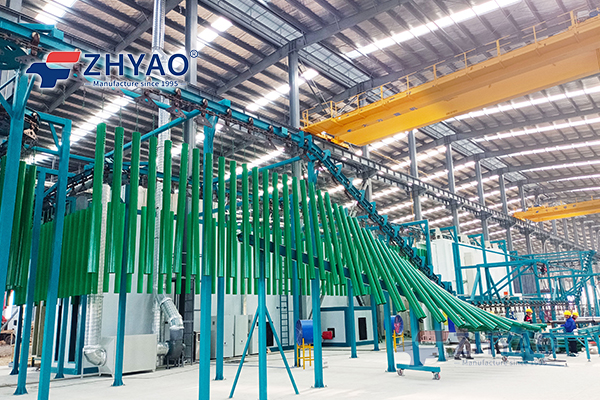
For products with relatively simple geometry, horizontal overhead conveying is often a practical arrangement. Workpieces can be suspended from hangers and transported through pretreatment, drying, spraying, and curing sections along a continuous path.
This arrangement is commonly used for metal furniture, electrical cabinets, agricultural machinery components, and other products that can be handled through overhead suspension.
However, the suitability of horizontal conveying depends on workpiece dimensions and the hanging arrangement. Long components may require additional spacing or support to prevent swinging and interference. Heavy workpieces may also require a conveyor with suitable load capacity and hanger design.
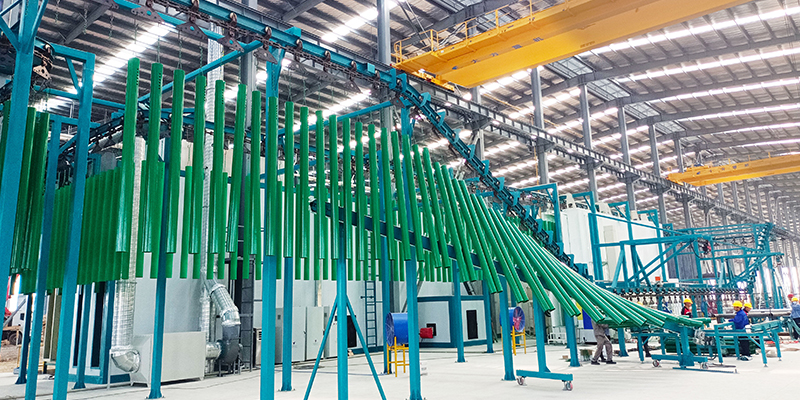
Vertical conveying can be useful when the workpiece orientation or the required production layout makes vertical movement advantageous. Certain long or narrow products may be transported in an upright position, while some systems use vertically arranged conveyor paths to connect different production levels.
These applications should not be treated as interchangeable. A conveyor designed to move workpieces vertically through a building has different requirements from a system that carries products in a vertical orientation during spraying.
The distinction matters because the conveyor's function, loading arrangement, and interaction with the coating process will differ.
Horizontal Conveying: A Practical Choice for Continuous Painting Lines
Horizontal conveyor systems are widely used in painting lines because they allow workpieces to move continuously through a sequence of process sections.
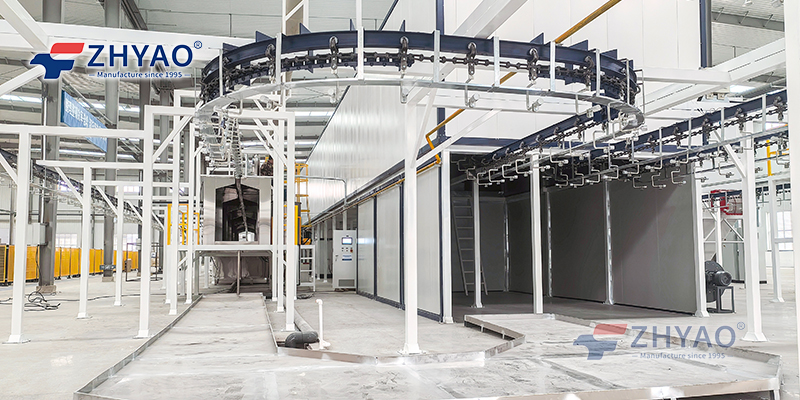
An overhead chain conveyor, for example, can carry workpieces through pretreatment, drying, spray booths, and curing ovens. The conveyor path can be arranged to suit the available factory space and the required process sequence.
One advantage of this arrangement is the ability to coordinate workpiece movement with the production cycle. Hanger spacing, conveyor speed, and loading density can be adjusted according to the required output and the dimensions of the products.
Horizontal conveying also provides flexibility in workpiece suspension. Different hanger designs can be used to accommodate various products, provided that the conveyor capacity and clearances are suitable.
However, horizontal conveying does not automatically provide better coating coverage.
When workpieces are suspended close together, adjacent parts can obstruct spray access. Large components may also create shadow areas, particularly around recessed surfaces or complicated structures.
The hanging arrangement must therefore be considered together with the spray gun positions and the movement of the workpieces through the coating area.
For products with relatively consistent dimensions and repeatable production requirements, horizontal conveying can provide a straightforward arrangement for continuous processing. For products with unusual geometry or handling requirements, the conveyor design may need additional consideration.
Vertical Conveying: When the Workpiece or Layout Benefits From Vertical Movement
Vertical conveyor systems can be useful when the production process requires workpieces to move between different levels or when the available layout makes vertical transportation practical.
For example, a production line may use a vertical conveyor section to transfer workpieces between process levels or to connect different areas of a factory. In other applications, products may be transported in an upright position to accommodate their dimensions or handling requirements.
The benefit depends on the specific arrangement.
A vertically arranged conveyor path may reduce the need for a long horizontal transfer route, but it introduces different considerations. Workpiece stability, loading and unloading positions, clearance between products, and access for maintenance all need to be evaluated.
If the workpieces are suspended vertically during spraying, their orientation also affects coating access. The spray guns must be positioned to reach the required surfaces, while the hanging arrangement must prevent excessive movement or interference.
Vertical transportation can be suitable for certain applications, but it is not inherently more space-efficient or easier to automate than horizontal conveying.
The available building height, workpiece geometry, process sequence, and required production rate determine whether vertical movement provides a practical advantage.
The Conveyor Layout Must Support Spray Gun Access
A conveyor system should not be selected independently of the spraying arrangement.
The workpiece position during spraying determines which surfaces are accessible and how the spray guns can be positioned. If the conveyor arrangement places parts too close together, adjacent workpieces may obstruct the spray pattern.
This can be particularly important for products with deep recesses, narrow openings, or complicated profiles.
For horizontal overhead conveying, hanger spacing and workpiece orientation influence the available spray access. For vertically transported workpieces, the spray gun arrangement must account for the orientation of the product and the surfaces that require coating.
Automatic reciprocators or robotic systems may be used when the required spray paths are repeatable. However, the conveyor must provide sufficiently consistent workpiece positioning for the selected automation to operate effectively.
A change in conveyor orientation does not automatically solve coating coverage problems. In some cases, modifying the hanger design or adjusting the spray gun positions may be more effective than redesigning the entire conveyor system.
The objective is to establish a suitable relationship between workpiece movement and spray access.
Consider the Complete Process Before Finalizing the Layout
A painting line typically includes several interconnected stages, such as pretreatment, drying, spraying, and curing. The conveyor must accommodate the requirements of each stage.
For example, the workpiece dimensions and hanging arrangement determine the clearance required inside the pretreatment equipment and curing oven. The conveyor speed and loading density influence the production cycle, while the workpiece orientation affects drainage and the accessibility of different surfaces during treatment.
A layout that works well in the spray booth may create difficulties in the oven or pretreatment section if the workpieces cannot be transported consistently through the entire process.
The conveyor route also needs to provide suitable loading and unloading positions, maintenance access, and clearance around the equipment.
This is why the conveyor layout should be developed together with the process arrangement rather than selected as an independent component.
Factory Space Is Only One Part of the Decision
Vertical and horizontal conveyor systems are sometimes compared primarily by their space requirements. However, floor area alone does not determine whether a layout is practical.
Horizontal conveying may require a longer production route, but it can provide straightforward access to equipment and workpieces. Vertical arrangements may reduce certain transfer distances or make use of available building height, but they can introduce more complex handling and maintenance requirements.
The actual layout depends on the factory's dimensions, workpiece size, process sequence, and the location of supporting equipment.
For example, a factory with sufficient floor space may find a horizontal overhead conveyor easier to install and maintain. A facility with restricted floor space but suitable building height may benefit from a vertically arranged transfer system.
Neither arrangement should be selected solely because it appears more compact.
A useful layout comparison considers the complete production area, including the conveyor route, spray booths, ovens, pretreatment equipment, loading and unloading stations, and maintenance access.
Choose the Conveyor That Matches the Production Requirements
Vertical and horizontal conveyor systems serve different transportation and layout requirements. Their suitability depends on how the workpieces are handled, how they move through the painting process, and how the coating equipment is arranged.
Horizontal overhead conveying is often practical for continuous painting lines with repeatable workpiece handling. Vertical conveying or vertically arranged transfer sections may be useful when the product orientation or factory layout makes vertical movement advantageous.
The important distinction is that conveyor orientation alone does not determine production efficiency or coating quality.
Workpiece geometry, hanging arrangements, spray access, conveyor capacity, and the complete process sequence must be considered together. A suitable conveyor layout is one that transports the products reliably while supporting the required coating process without introducing unnecessary complexity.
FAQ
Can a vertical conveyor system replace a horizontal conveyor in a painting line?
Not in every application. Vertical and horizontal conveyor systems serve different transportation and layout requirements. The appropriate choice depends on workpiece dimensions, handling arrangements, process sequence, available factory space, and the required production rate.
Does a vertical conveyor system always save more factory space?
No. A vertical arrangement may reduce certain horizontal transfer distances or make use of available building height, but its overall space requirements depend on the equipment layout, loading and unloading positions, maintenance access, and workpiece handling requirements.
 Electrical Control Systems in Coating Lines: How Equipment Coordination Affects Production
 Vertical vs. Horizontal Conveyor Systems in Painting Lines: How to Choose the Right Layout
 Powder Coating vs Liquid Painting: Which Process Is Better for Your Product?
 Batch Oven vs. Continuous Oven: How to Choose the Right Curing System for Your Production Needs