
From Single Machine to Complete Line: How Automated Powder Coating Equipment Reshapes Coating Line Efficiency
"A coating line saved 1.5 hours per day while increasing powder recovery by 8%" and "Color change time reduced from 45 minutes to 8 minutes"—these aren't
marketing rhetoric; they're real-world data from a recent upgrade of automated powder coating equipment for a metal furniture manufacturer. If you're evaluating
a new production line or considering retrofitting an old one, the following tips may help you avoid some setbacks.
1. Taking the "Automated Powder Coating Equipment" Apart: Where Does Automation Really Matter?
Powder Supply Center: Closed-loop flow control ensures powder output fluctuations of less than ±2%, reducing manual powder replenishment.
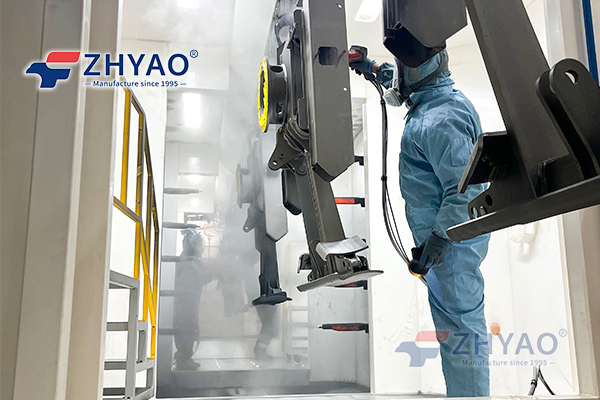
Reciprocating Machine/Robot: A six-axis robot plus laser tracking solves the perennial problem of uneven coating thickness on irregularly shaped parts.
Spray Booth Recovery: Large cyclones plus two-stage recovery with coated filters ensure a stable powder utilization rate of over 95%.
Curing Oven: Segmented temperature control plus hot air circulation ensures oven temperature fluctuations of ≤±3°C, achieving a first-pass color difference pass
rate of 97%. Only by combining the above modules can we create a true powder coating production line, not a simple "standalone machine + conveyor belt" assembly.
II. Why the "Complete Line Approach" is Becoming More Popular
In the past, many factories invested their entire budget in a single high-end automatic powder coating machine, but overlooked the coordination between the preceding
and following links:
Residual water marks from pre-treatment → Post-spray craters
Unstable conveyor speed → Fluctuating film thickness
Slow curing oven temperature rise → Production bottlenecks
We analyzed data from 30 production lines and found that after the entire line was upgraded, energy consumption per part decreased by an average of 14% and yield
increased by 12%. In other words, evaluating the ROI of automatic powder coating equipment within the context of an entire coating production line is more reliable
than simply looking at the metrics of individual machines.
III. Avoiding Pitfalls in Selection: Three Often Overlooked Details
Color Change Requirements: If color changes occur more than 15 times per month, it is recommended to select a powder supply center with PPH rapid gun cleaning.
Otherwise, the 15-minute gun cleaning time per change will eat into profits. Factory Height: Six-axis robots require a clearance of 4.2 meters or more. This must be
reviewed before renovating existing factories.
Environmental Impact Assessment: Powder emissions in some regions must be ≤10 mg/m³. Secondary recovery modules must be equipped with membrane filters,
not traditional bag filters.
IV. Real-World Case Study: A Metal Furniture Factory with a Monthly Production Capacity of 150,000 Chairs
Pain Points: Manual powder spraying and a toaster oven, resulting in over 30 color difference complaints per month.
Renovation Plan:
– Added silane pretreatment and dual-station water blowdown;
– Utilized a six-axis robot and a rapid color change powder supply center for the automatic powder coating system;
– Converted the curing oven to a bridge-type drying tunnel for waste heat recovery.
Result: Production capacity increased from 1,200 pieces/shift to 1,900 pieces/shift, and powder consumption per unit decreased from 1.4 kg to 1.1 kg, achieving a
one-year payback period.
V. Price: Ask "Take Time" First, Then "Quote"
Many customers start by asking, "How much does automatic powder coating equipment cost?" without providing specific information on daily production output
and cycle time. We typically start by creating a requirements table: workpiece size, weight, daily production capacity, color change frequency, and factory constraints.
Once these requirements are aligned, the price of the same powder coating line can range from 800,000 to 2.2 million RMB, with the difference coming from key
configurations like robot brand, recycling level, and curing oven heating method.
VI. Maintenance and Upgrades: Making Your Line More Valuable
Daily: Check for wear on the spray gun electrode needle and clean powder accumulation at the bottom of the cyclone.
Monthly: Calibrate the powder pump flow and test the filter pressure differential.
Yearly: Perform an accuracy calibration on the robot and reciprocating machine, and perform a heat distribution test on the curing oven.
Incorporate maintenance SOPs into your production line manual. After three years, you'll find that while energy consumption on other powder coating lines has
increased, yours has decreased.
Automated powder coating equipment is no longer simply about "spraying powder"; it's the key to the efficiency, cost, and quality of the entire coating line.
If you're planning a new production line or looking to painlessly upgrade an existing one, please bring your specific workpieces and production rates to discuss.
We'll start with the data and then discuss the solution.
 How to Calculate the Production Capacity of a Powder Coating Line
 Powder Coating Line Process Explained: From Pretreatment to Final Curing
 Powder Coating vs Wet Painting Differences Explained
 Why Powder Coating Creates a Durable Surface Layer