
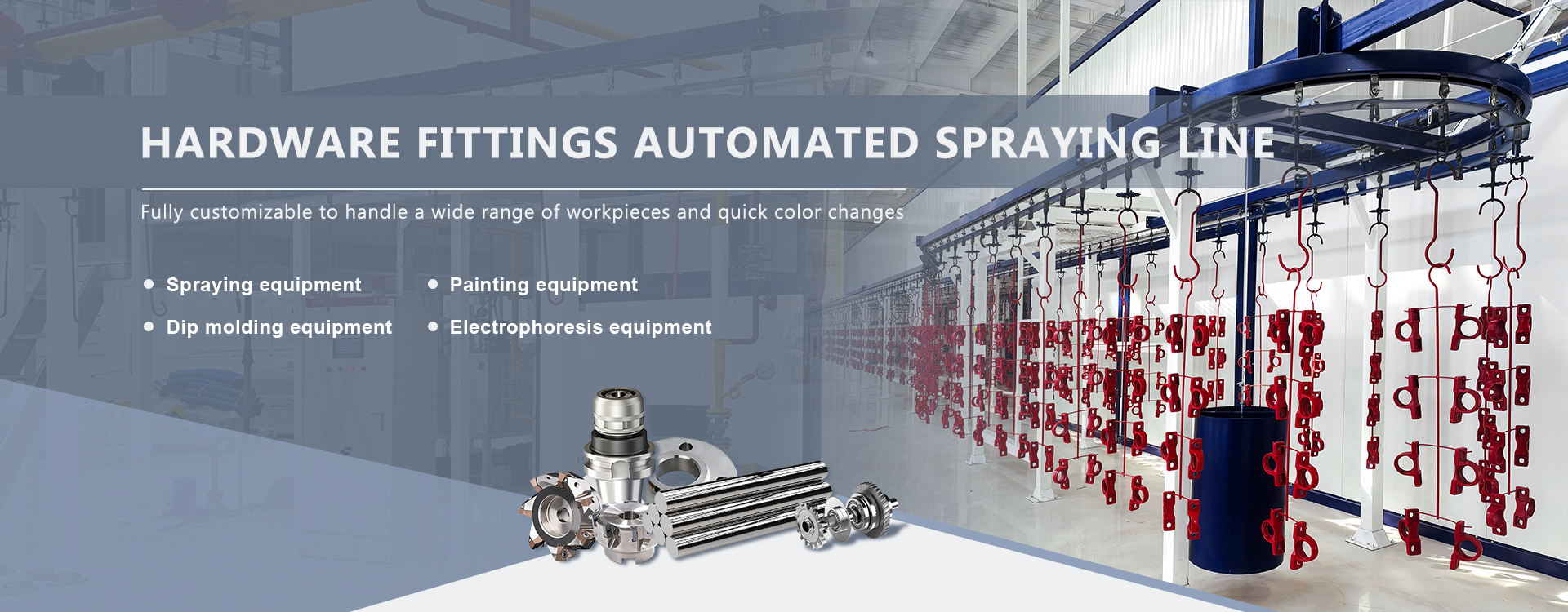
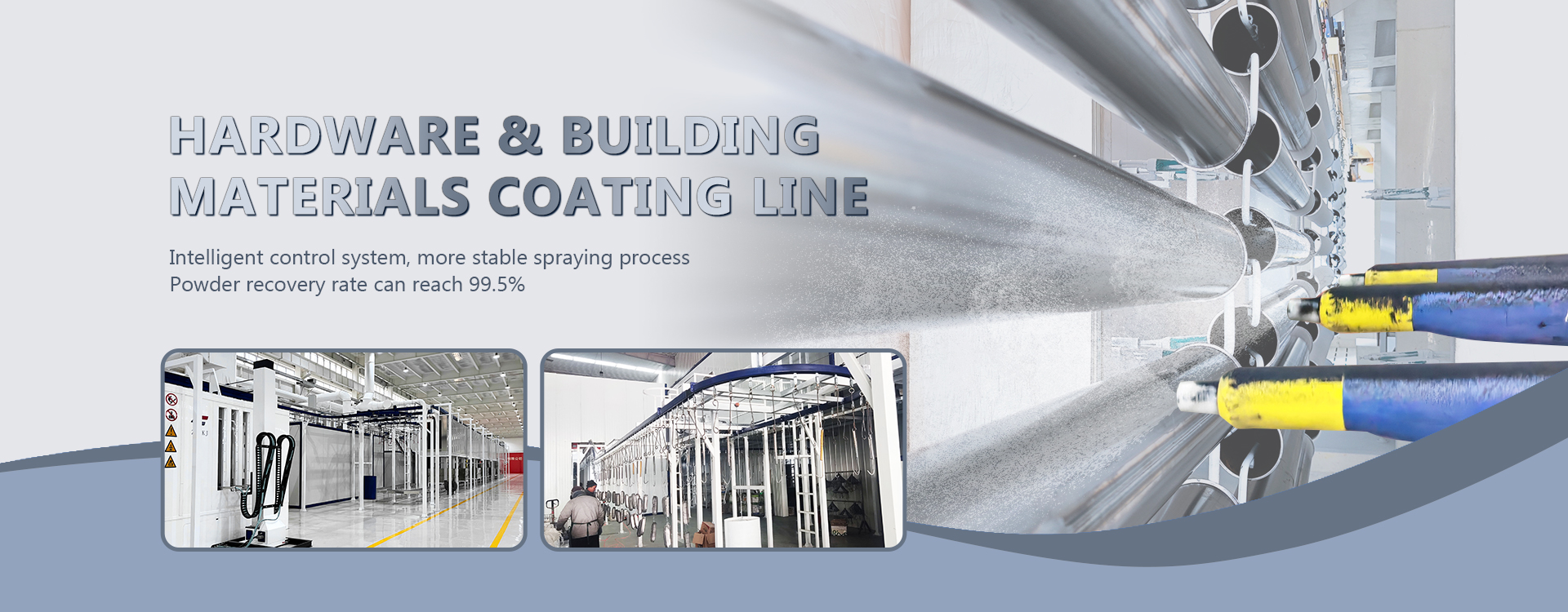
What spray coating equipment is best for guardrails?
Guardrails are constantly exposed to coastal salt spray, industrial acid rain, and ultraviolet radiation. Traditional manual spray coating suffers from defects
such as large film thickness variations, insufficient edge coverage, and significant powder waste. The fully automated guardrail spray line integrates spray
and powder coating equipment to achieve closed-loop control of pre-treatment, coating, and curing processes, thereby increasing salt spray resistance
from the typical 480 hours to over 1000 hours and reducing powder consumption per unit.

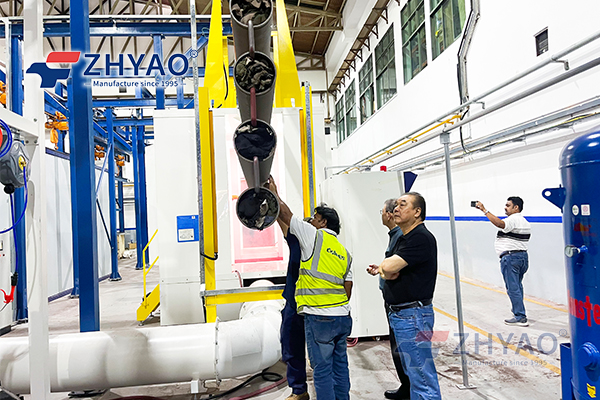
(Guardrail spraying line)
II. System Configuration and Functional Division
Loading and Conveying Unit
• A C-type dual-point suspension system, with a single point load capacity of 50 kg and four synchronized lifting points, ensures a lateral swing of less
than 2 mm for a 4-meter-long guardrail operating at a height of 3 meters.
• The friction drive system supports accumulation and release and 0–15° tilting. RFID-based lifter identification interfaces with the MES, enabling
variable process routing for individual parts. Pretreatment Module
• Three-stage spray degreasing (45°C ± 2°C, free alkalinity 8–12 pt) + room-temperature phosphorus-free conversion (zirconium-titanium system, film
weight 0.3–0.5 g/m²);
• A V-shaped deflector design at the bottom ensures complete return of residual liquid from the inner cavity, preventing "yellow spot" defects.Spraying
Equipment Area
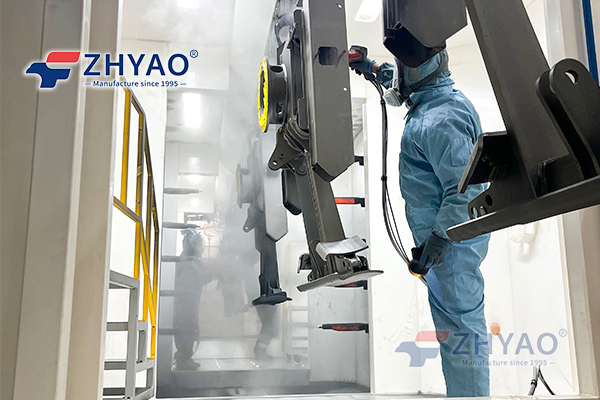
• Six-axis robot + automatic reciprocating machine collaboration: The robot handles the visible surface, while the reciprocating machine is equipped
with a long gun to penetrate the inner cavity;
• Electrostatic powder spraying equipment equipped with 60–90 kV adjustable high voltage and closed-loop current control, with powder output
fluctuation ≤±2%;
• Rapid color change powder supply center: Cyclone separation + secondary recovery of membrane filter element, color change time ≤12 minutes.
Curing Oven
• Natural gas direct-fired hot air circulation furnace with zoned temperature differential control (±3°C), chain speed and furnace temperature
PID linkage;
• Furnace inlet air curtain + waste heat recovery heat exchanger, reducing overall energy consumption by 15%.
Cooling and Workpiece Unloading
• The forced cooling section uses variable frequency side blowing, reducing the workpiece surface temperature to below 40°C within 5 minutes;
• An end-of-line vision inspection system measures film thickness, color difference, and missed sprays, with data automatically archived.
III. Key Process Parameter Control
• Target film thickness 80–120 µm, CV ≤ 5%;
• Curing conditions 200°C × 10 min (PMT recording);
• Powder utilization ≥ 97%, recycled powder content ≤ 15%
IV. Common Problems and Improvement Measures
Cavity Sagging: Reduce gun distance, increase gun speed, and add pulse backflush to the powder coating equipment.
Post-curing Color Variation: Calibrate the curing oven temperature probe monthly to ensure ΔE ≤ 0.5.
Conveyor Chain Jitter: Measure chain elongation quarterly. If it exceeds 2%, immediately cut or replace the chain.
The fully automated guardrail spraying line integrates conveying, spraying, and powder coating equipment with information systems, enabling
quantifiable, replicable, and traceable
protection performance throughout the guardrail's lifecycle. In the future, with the further introduction of digital twins and AI vision, the system
will continue to evolve toward the goal of "zero defects and zero color change downtime."
 How to Calculate the Production Capacity of a Powder Coating Line
 Powder Coating Line Process Explained: From Pretreatment to Final Curing
 Powder Coating vs Wet Painting Differences Explained
 Why Powder Coating Creates a Durable Surface Layer